Table of Contents
Introduction to the Building Bill 2083 Nepal
Housing is not merely a Physical structure, it is a part of human dignity, security and adequate standard of living. Basically, housing is more than just a shelter. The idea of housing as social and economic rights is emerged in 1944 by the U.S. President Franklin D. Roosevelt through proposing "Second Bill of Rights," which included "the right of every family to a decent home."
Later, International human Right laws recognized right to housing as basic human right. Article 25(1) of the Universal Declaration of Human Rights (UDHR) includes housing within the right to an adequate standard of living Similarly, Article 11(1) of the ICESCR expressly recognizes the right to adequate housing.
Article 37 (1) of Constitution of Nepal also provides provision of "Every citizen shall have the Right to appropriate housing." An appropriate house is not only about having roof under you or having a place to live. It means you have a home that is safe, properly constructed and legally protected.
In Nepal, Construction and building is governed by Building Act 2055, which focuses mainly on building safety, standard and permit through National Building code. However, building act 2055 is two decades older and does not comply with Constitution, federal structure, modern construction practices, disaster risks and changing housing needs. Therefore, the Building Bill, 2083 seeks to update and strengthen the existing legal framework.
Key Weaknesses of the Building Act 2055 in Nepal
It heavily focuses on engineering standards, structural safety and map approval of building construction treating it as purely technical rather than an issue of urban planning.
There is absence of welfare and housing rights in this act, it does have a provision of housing subsidies or financial assistance for low-income households.
This act predates the federalism and lack of coordinating mechanism among the three level of government.
It also lacks legal frameworks to identify, manage, relocate or rehabilitate high-risk and disaster-prone human settlements living in ecologically fragile zones.
The maximum fine of Rs 50000 may not effectively deter illegal or unsafe construction.
Hence, the new building bill is urgently needed to replace the outdated building act. Unlike this act which heavily focuses on the engineering standard, the new building bill 2083 have a provision of comprehensive urban planning, housing rights and financial support for low-income families and also includes a clear coordination among federal, provincial, and local governments which the old act lacks.
It also has a legal framework regarding relocating communities in high-risk disaster zones and replaces the outdated Rs. 50,000 fines with much stronger penalties to prevent illegal building construction.
About the Building Bill 2083 Nepal
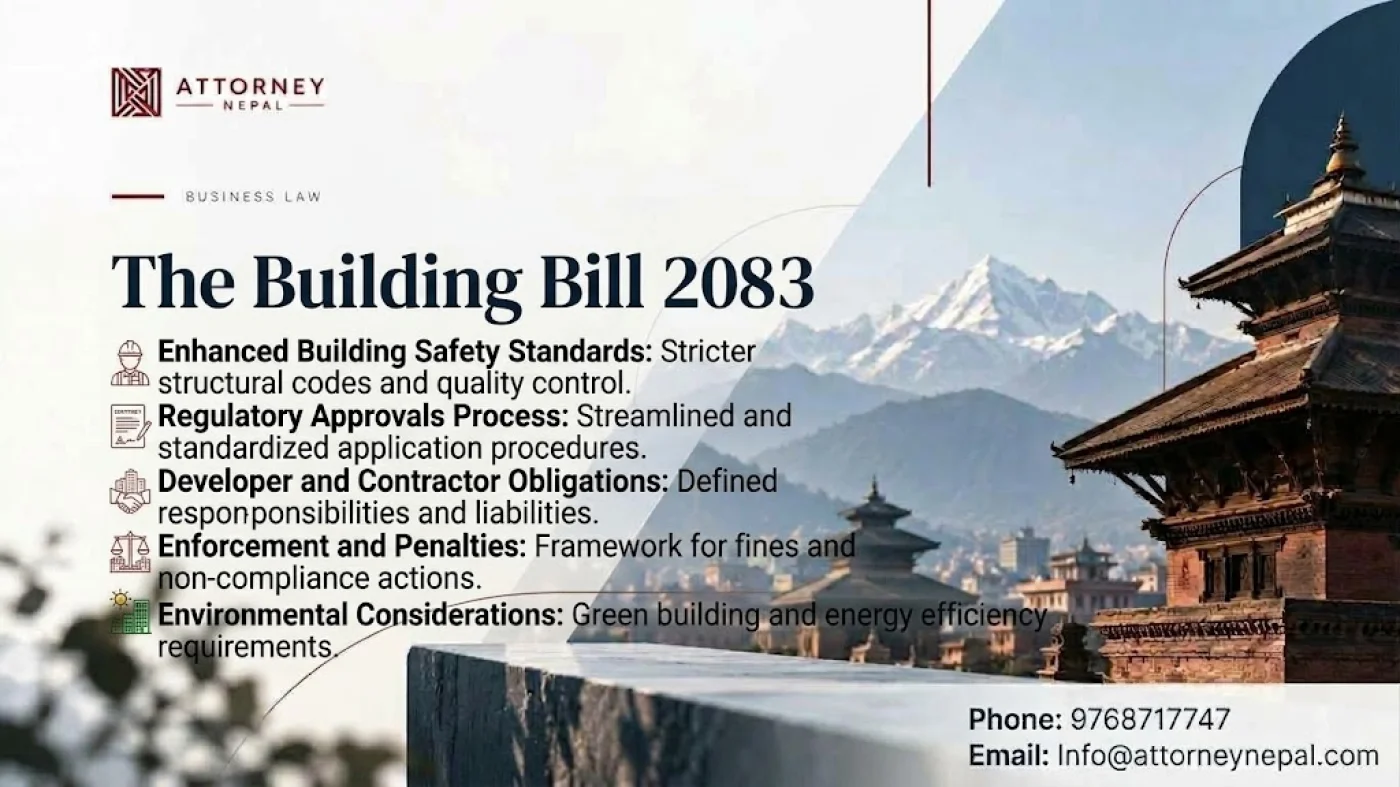
It is an amendment of building act 2055, expanding the scope of the act with the concept welfare and right to housing rather than merely focus on standard, safety and permit. The Ministry of Infrastructure Development has registered the Building Act 2083 bill at the Federal Parliament Secretariat, proposing to legally guarantee every Nepali citizen's right to housing, from free construction materials for first-time home builders to subsidized smart homes for middle-income families.
According to the proposed Building bill 2083, it will fix the problems and outdated provision of Building act 2055. It also says that the Act's lifecycle regime such as planning, design, construction, maintenance, safety assessment and end-of-life was thin and the enforcement was weak.
Major Provisions of the Building Bill 2083
Expanded Objectives and Green Goals in Building Bill 2083
Preamble of the bill, how it expanded the objectives of the act from 2055 to bill 2083 including the entire life of the building not just initial construction. It has also included modern and green goals such as climate adaptation, disaster resilience and environmental sustainability. It also encourages use of indigenous skills and construction and local materials.
New Definitions Introduced by Building Bill 2083
Included new definitions such building safety assessment, high-risk building, qualified technician, designer, supervisor, peer review, retrofitting, smart home, cattle shed (goth), first residential house, local and indigenous materials, local architecture and standard design. It also replaces local level with municipality.
Building Classification Under Section 8 of Building Bill 2083
Section 8 of the proposed bill has categorized 8 classifications of building such as:
Class A (Ultra-Modern/Advanced Buildings)
Class B (larger building): Plinth area exceeding 1,000 square feet. Height exceeding 3 floors. Structural span exceeding 4.5 meters
Class C (Standard Residential & Traditional Buildings): Plinth area up to 1,000 square feet, up to 3 storeys and a structural span up to 4.5 meters.
Class D (Low-Rise / Rural Traditional Structures): Buildings up to two storeys constructed using mud-mortar or cement-mortar brick, stone, mud, bamboo and timber.
Class E (Indigenous & Vernacular Architecture): Building by traditional or indigenous architecture, construction materials, skills or technology.
Class F (Residential Smart Homes)
Class G (Sheds)
It has provision regarding new construction material which is not mentioned or covered in the code need a ministerial approval.
National Building Record and E-Permit System in Building Bill 2083
It has provided the National building record and e permit system which ensure that each building gets a unique ID and a lifecycle record.
Periodic Building Safety Assessment Under Building Bill 2083
Included the provision related to Periodic Building Safety Assessment and Continued Use of Existing Buildings where Buildings of specified categories must undergo regular safety assessments by qualified technicians. Local bodies also have a power order special assessments after disasters, alterations, or changes in use.
Offenses and Penalties Under Building Bill 2083
It is prohibited to build without approved design and map, violating of the approved map, design or building code criteria and building with alterations to the approved map without obtaining required re-approval.
Fines are Rs 5 to 10 lakh for building contrary to the rules in class A or B (Fine Rs 5 lakh for other classes.)
Fine Rs 3 to 5 lakh for the specified breach in class A or B (Rs 2 lakh for others).
The local level can order work stopped or demolition. It can also freeze the property against transfer or mortgage and cut water, electricity and telephone connections.
Heritage and Traditional Construction Protection Under Building Bill 2083
Protect and promote traditional Construction and Heritage by all three level of government.
Safe Housing for Vulnerable and Disaster-Affected Families
Provision relating to Safe Housing for Vulnerable and Disaster-Affected Families are there, in which Safe and resilient housing, free construction materials and technical support will be provided to disaster-affected, high-risk or informal settlers through shared funding.
Building Safety Assistance Fund in Nepal
Provision of establishment of Building Safety Assistance Fund.
Citizen Housing Assurance and Cash Grants Under Building Bill 2083
Every citizen is guaranteed access to a safe first residential home and animal shed.
Extremely poor families building their first home will receive cash grants of at least Rs 50,000 from the Federal Government and Rs 25,000 from the Provincial Government total Rs 75,000.
Rationale Behind the Introduction of Building Bill 2083 Nepal
Constitutional Right to Housing in Nepal
To ensure constitutional right to appropriate housing as it legally guarantee every citizen's right to housing and moving beyond mere government welfare schemes to establish institutional and legal accountability.
Disaster Resilience and Building Safety in Nepal
To ensure Disaster Resilience and Safety. As we have already seen Nepal faces earthquakes, floods and landslides. Because of this the bill requires risk assessments before any new construction begins. It also calls for structural evaluations of buildings to check their safety. All new buildings must follow earthquake-resistant standards. This is meant to reduce damage and protect people during disasters.
Support for Low and Middle-Income Citizens Under Building Bill 2083
To support for Low and Middle-Income Citizens as well as homeless who lost their home in recent flood of Rasuwa, Nuwakot and other effected areas.
Modernization and Digital Governance of Building Regulation in Nepal
To Modernization and Digital Governance by mandating a National Building Archive and digital permit systems, across levels to bring transparency, standardization, and easy cross-referencing to urban planning and structural compliance.
Critical Analysis of the Building Bill 2083 Nepal
Strengths and Progressive Aspects of Building Bill 2083
Implementation of Constitutional Right to Housing.
Targeted Smart Homes and Affordable Financing.
Introducing a full life-cycle approach to regulation which requires risk assessments before construction begins. It also creates a national building archive.
Potential Challenges and Implementation Hurdles of Building Bill 2083
Subsidies, interest grants and free materials require a lot of money. Nepal's weak revenue base could create a lot of pressure on the budget.
Rural and small municipalities often do not have enough engineers, staff or infrastructure to handle e‑permits, digital records and monitoring.
The risk of patronage and duplicate claims rises in beneficiary selection unless the process remains transparent and driven by data.
Inadequate Funding, Rs 75,000 only covers a part of the cost to build even one safe earthquake-resistant room and it is even more difficult to build a house.
Legislative Overlap: When housing grants and financing are placed into a building law, housing grants and financing overlap with housing laws and may confuse administrative jurisdiction. I feel that this mix can create confusion, for everyone involved.
Conclusion: The Future of Housing Rights in Nepal
The Building Bill 2083 improves the Building Act, 2055 as the Building Bill 2083 covers the life of a building from its design to its demolition. The Building Bill 2083 also strengthens disaster safety. Imposes tougher penalties than building act 2055. The Building Bill 2083 recognizes the right to housing. However, limited funding, weak local capacity and overlap with housing laws could hinder its effect. With adequate funding and clear implementation, it can deliver safe and appropriate housing.
Frequently Asked Questions
The Building Bill 2083 is a proposed amendment to the Building Act 2055, registered by the Ministry of Infrastructure Development at the Federal Parliament Secretariat. The right to housing is legally guaranteed by this bill, and provisions for building safety, urban planning, and financial support for low-income families are included.
Building safety, standards, and map permits were the only focus of the Building Act 2055, while welfare and housing rights were not covered. A full building lifecycle approach, disaster resilience, e-permit systems, and housing cash grants are introduced by the Building Bill 2083. The outdated Rs 50,000 maximum fine is also replaced with penalties of up to Rs 10 lakh.
Fines of Rs 5 to 10 lakh are imposed for construction contrary to the rules in Class A or B buildings, and Rs 5 lakh is set for other classes. Work stoppage, demolition orders, property freezing, and disconnection of water, electricity, and telephone services can also be ordered by local bodies.
A cash grant of at least Rs 50,000 is provided by the Federal Government, and Rs 25,000 is provided by the Provincial Government, totaling Rs 75,000 for extremely poor families building their first home. Free construction materials and technical support are also guaranteed for disaster-affected and high-risk settlers.
Yes. The right to appropriate housing is provided to every citizen under Article 37(1) of the Constitution of Nepal 2015. Legal enforcement of this constitutional right is intended through the Building Bill 2083, moving beyond welfare schemes to institutional accountability.
This article is for general informational purposes only and does not constitute legal advice. For advice on your specific situation, please contact Attorney Nepal directly.