

Are you planning to expand your business into South Asia? Foreign company registration in Nepal has become one of the most searched legal topics by international investors in 2026. Therefore, this guide has been prepared to explain every step, document, cost, and compliance obligation in plain language.
Nepal's market is growing steadily. The Foreign Investment and Technology Transfer Act, 2075 (FITTA) has been amended. The automatic route for foreign investment has been expanded. As a result, entry into Nepal has become faster than ever before.
However, the process is still multi-layered. Approval from the Department of Industry, registration at the Office of the Company Registrar, tax registration, and Nepal Rastra Bank notification must all be completed. Consequently, professional guidance is strongly recommended.
In this tutorial, everything will be explained step by step. First, the legal framework will be covered. Then, the registration process will be broken down. After that, costs, timelines, and compliance requirements will be presented in tables. Finally, frequently asked questions will be answered.
What Is Foreign Company Registration in Nepal?
Foreign company registration in Nepal is the legal process through which a company incorporated outside Nepal is authorized to operate within Nepali territory. It can be done through three main structures.
Branch Office Registration in Nepal
A branch office is an extension of the parent foreign company. Under Section 154 of the Companies Act, 2063, a foreign company must register a branch office before conducting business in Nepal. Notably, no minimum capital is prescribed for a branch office. However, approval from a competent sectoral authority or a project agreement with a government body is required.
Subsidiary Company Through FDI in Nepal
A subsidiary is a separate Nepali legal entity. It is established through foreign direct investment under FITTA 2075. A minimum investment of NPR 20 million is generally required. However, no minimum applies to eligible IT sector investments under the automatic route. Wholly foreign-owned subsidiaries are permitted in most sectors.
Liaison Office Registration in Nepal
A liaison office (representative office) cannot earn income in Nepal. Market research, coordination, and promotion of the parent company's business are permitted. Registration at the OCR is mandatory. Moreover, annual reporting to the Office of the Company Registrar is required.
Legal Framework for Foreign Company Registration in Nepal
Several laws govern the entry of foreign businesses. Understanding them is essential before any application is filed.
| Law / Regulation | Governing Authority | Key Provision |
|---|---|---|
| Companies Act, 2063 (2006) | Office of the Company Registrar | Section 154–155: branch and liaison office registration |
| Foreign Investment and Technology Transfer Act, 2075 (2019) | Department of Industry | Foreign investment approval, automatic route |
| FITTA Regulation, 2077 | Department of Industry | Implementation procedures, Single Point Service Center |
| Industrial Enterprises Act, 2076 | Department of Industry | Industry registration before operation |
| Income Tax Act, 2058 | Inland Revenue Department | PAN registration, 25% corporate tax rate |
| Nepal Rastra Bank Act, 2058 | Nepal Rastra Bank | Foreign investment recording, capital injection |
| Labor Act, 2074 | Department of Labor | Employment compliance, Social Security Fund |
The negative list under Section 50 of FITTA restricts foreign investment in certain sectors. For example, retail trade, arms and ammunition, real estate business (other than construction), and mass media in national languages are prohibited. On the other hand, manufacturing, hydropower, tourism, IT, and financial services remain open.
Step-by-Step Foreign Company Registration Process in Nepal
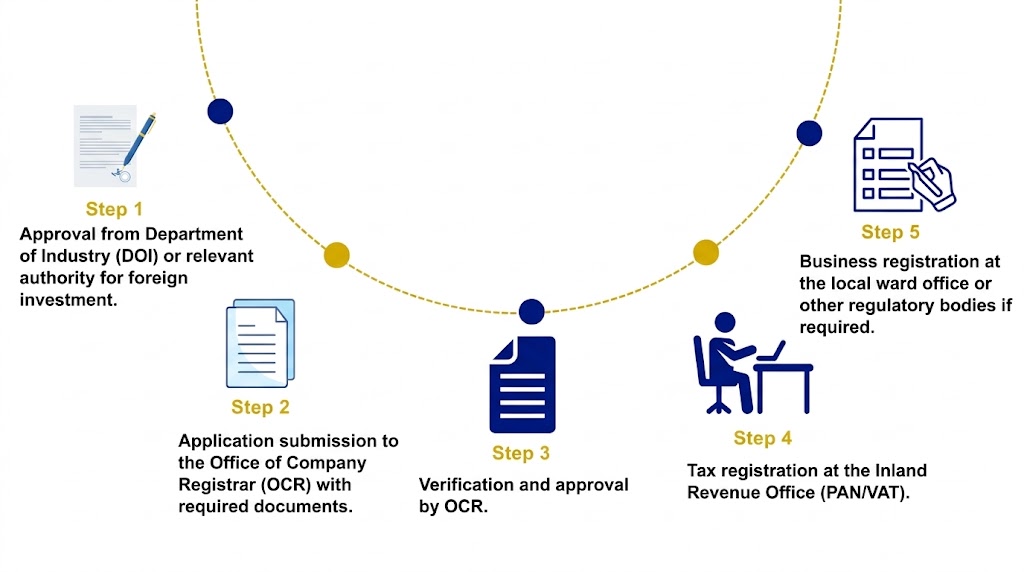
The foreign company registration process in Nepal is completed in seven clear stages. Each stage is explained below.
Step 1: Sector Verification and Structure Selection
First, the negative list of FITTA must be checked. After that, the correct structure (branch, subsidiary, or liaison) must be chosen. This decision affects capital requirements, tax treatment, and liability.
Step 2: Pre-Approval From the Competent Authority (Branch Offices)
For a branch office, prior approval from the sectoral regulator is mandatory. For instance, a foreign bank needs Nepal Rastra Bank approval. Similarly, an IT company needs approval from the Ministry of Communication and Information Technology. Infrastructure companies usually proceed under a project agreement with a government agency.
Step 3: Name Reservation and Document Preparation
Next, the parent company's documents must be prepared. Certificates of incorporation, MOA, AOA, and board resolutions must be notarized and legalized in the country of origin. Furthermore, Nepali translations must be attached. Passports of all directors and a Power of Attorney for the Nepali representative are also required.
Step 4: Registration at the Office of the Company Registrar
The application is submitted to the OCR under Section 154 (branch) or Sections 3–5 with FDI approval (subsidiary). The OCR reviews the documents. Registration is legally required to be completed within 30 days of a complete application.
Step 5: FDI Approval and Industry Registration (Subsidiary Route)
For a subsidiary, approval from the Department of Industry must be obtained first. Under the automatic route, eligible investments receive electronic approval. Afterwards, industry registration is completed under the Industrial Enterprises Act, 2076.
Step 6: PAN, VAT, and Local Registration
Then, a Permanent Account Number is obtained from the Inland Revenue Department. VAT registration is added if the turnover threshold is met. Finally, business registration is completed at the local ward or municipality office.
Step 7: Bank Account and Nepal Rastra Bank Notification
A corporate bank account is opened. For FDI companies, capital injection is staged: 25% within 3 months, the next 15% within 6 months, and 10% within 9 months of approval. Thereafter, 70% must be injected before commercial operation, and the remaining 30% within 2 years. The investment must be recorded at Nepal Rastra Bank within 6 months of approval.
Documents Required for Foreign Company Registration in Nepal
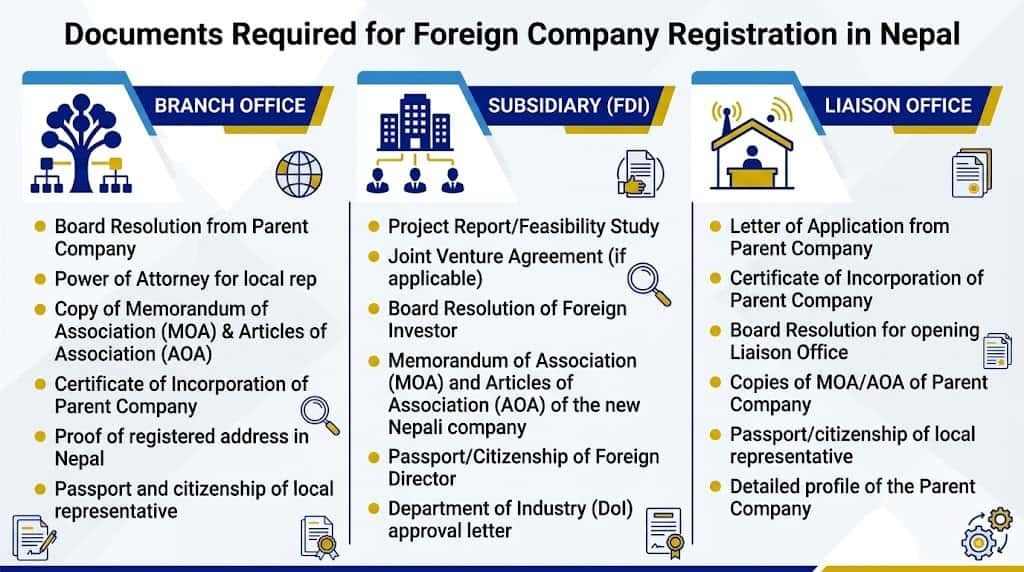
Proper documentation determines the speed of approval. The complete checklist is provided below.
| Document | Branch Office | Subsidiary (FDI) | Liaison Office |
|---|---|---|---|
| Certificate of incorporation (notarized) | Yes | Yes | Yes |
| MOA and AOA of parent company | Yes | Yes | Yes |
| Board resolution authorizing Nepal operations | Yes | Yes | Yes |
| Passports of all directors (notarized) | Yes | Yes | Yes |
| Power of Attorney for Nepali representative | Yes | Yes | Yes |
| Appointment letter of authorized representative | Yes | Yes | Yes |
| Competent authority approval / project agreement | Yes | Sector-dependent | Yes |
| Proposed investment details | Yes | Yes | Budget details |
| FDI approval letter (DOI) | No | Yes | No |
| Declaration of accuracy by directors | Yes | Yes | Yes |
| Nepali translations of all foreign documents | Yes | Yes | Yes |
Documents not in Nepali must be translated, notarized, and legalized. Without this, the OCR will reject the application.
Cost and Timeline of Foreign Company Registration in Nepal
The cost of foreign company registration in Nepal depends on the structure chosen. An approximate breakdown is shown below.
| Item | Estimated Cost (NPR) | Timeline |
|---|---|---|
| Document notarization and legalization (home country) | 30,000 – 150,000 | 1–2 weeks |
| OCR registration fee (branch) | 100,000 fixed or 0.1% of proposed investment | — |
| OCR registration fee (subsidiary) | 9,500 – 20,000 | — |
| FDI approval (DOI, automatic route) | 5,000 – 30,000 | 1–7 days |
| PAN and VAT registration | Free | 1–3 days |
| Industry registration (DOI) | 5,000 – 50,000 | 7–30 days |
| Professional/legal service fees | 300,000 – 1,500,000+ | — |
| Total estimated cost | NPR 450,000 – 1,800,000+ | 4–8 weeks overall |
Typically, branch office registration takes 2–3 weeks after a complete application. Meanwhile, a subsidiary route takes 1–2 months from FDI approval to full operation.
Branch Office vs Subsidiary vs Liaison Office in Nepal
Choosing the right structure is the most important decision. The comparison below will help.
| Feature | Branch Office | Subsidiary (FDI Company) | Liaison Office |
|---|---|---|---|
| Separate legal identity | No | Yes | No |
| Income-generating activity | Yes | Yes | No |
| Minimum investment | None | NPR 20 million (waived for eligible IT) | None |
| Parent liability | Unlimited | Limited to shares | Unlimited |
| Tax rate | 25% on Nepal income | 25% standard | No local income |
| Repatriation of profits | Allowed with NRB approval | Dividend repatriation allowed | N/A |
| Best for | Project-based work | Long-term market operations | Market research only |
Post-Registration Compliance for Foreign Companies in Nepal
Registration is only the beginning. Continuous compliance protects the business from penalties and cancellation.
First, an auditor must be appointed within 3 months of registration. Second, audited financial statements must be filed with the OCR within 6 months of each fiscal year end. Third, the parent company's financial statements must be submitted within 3 months of their preparation. In addition, quarterly compliance reports are required for branch offices.
Tax compliance is equally important. Annual income tax returns must be filed. Advance tax must be deposited on the 40%–70%–100% schedule. Moreover, Social Security Fund registration is mandatory once employees are hired.
Furthermore, any change in ownership, shareholding, or beneficial ownership must be reported to the Department of Industry within 30 days under FITTA. Finally, annual industry registration renewal and ward-level business renewal must not be missed.
Common Mistakes to Avoid During Foreign Company Registration in Nepal
Many applications are delayed because of avoidable errors. Therefore, these points should be noted carefully.
- Skipping notarization and legalization: Foreign documents without proper authentication are rejected outright.
- Wrong structure selection: A liaison office cannot earn revenue. Choosing it for commercial operations creates legal risk.
- Missing sectoral approval: OCR registration without the competent authority's approval is invalid.
- Delayed NRB recording: Failure to record the investment within 6 months blocks capital injection and repatriation.
- Ignoring the capital injection schedule: Late injection attracts penalties and cancels incentives.
- Poor Nepali translation: Incomplete translations cause repeated OCR queries.
Why Choose Attorney Nepal Pvt Ltd for Foreign Company Registration in Nepal?
The process involves multiple authorities, strict documentation standards, and tight deadlines. Therefore, a single error can cost months. At Attorney Nepal Pvt Ltd, foreign company registration is handled end to end — from structure selection and document legalization to OCR registration, DOI approval, tax setup, and NRB compliance.
A dedicated corporate team manages each file. Regular updates are provided at every stage. As a result, registration is completed faster, and compliance risk is minimized.
Call to action: Contact Attorney Nepal Pvt Ltd today for a free consultation on foreign company registration in Nepal. Your Nepal operations can begin within weeks — not months.
Frequently Asked Questions on Foreign Company Registration in Nepal
1. Can a foreign company own 100% of a Nepali company?
Yes. Full foreign ownership is permitted in most sectors under FITTA 2075. Only the negative list sectors are restricted.
2. What is the minimum investment for foreign company registration in Nepal?
For a subsidiary, NPR 20 million is the general minimum. However, no minimum applies to eligible IT investments under the automatic route. Branch and liaison offices have no minimum capital requirement.
3. How long does foreign company registration take in Nepal?
A branch office is usually registered in 2–3 weeks after documents are complete. A subsidiary typically takes 1–2 months including FDI approval, OCR registration, and tax setup.
4. Is a liaison office allowed to earn income in Nepal?
No. A liaison office may only conduct coordination, research, and promotional activities. All funding must come from the parent company.
5. What taxes does a foreign branch office pay in Nepal?
A branch pays corporate income tax at 25% on income sourced in Nepal. VAT applies if registration thresholds are met. Branch profits can be repatriated with Nepal Rastra Bank approval.
6. What is the automatic route for foreign investment in Nepal?
Under the automatic route, eligible FDI applications receive electronic approval from the Department of Industry without case-by-case review. The route now covers over 100 sectors, and the previous NPR 500 million ceiling has been removed.
7. Can foreign companies buy property in Nepal?
No. Foreign companies and individuals cannot directly own land in Nepal. Property is usually held through long-term leases or by Nepali-registered subsidiaries under permitted structures.
8. What happens if compliance is ignored after registration?
Penalties, fines, suspension of registration, and even cancellation can be imposed. Directors may also face personal liability under the Companies Act, 2063.
9. Are foreign directors required to visit Nepal for registration?
No. The entire process can be completed through a Power of Attorney. However, documents must be properly notarized and legalized in the home country.
10. Which authority registers a foreign branch office in Nepal?
The Office of the Company Registrar (OCR) registers branch and liaison offices under Sections 154 and 155 of the Companies Act, 2063, after competent authority approval is obtained.
References
For verification and further reading, the following official and high-authority sources are recommended:
- Office of the Company Registrar, Nepal — official company and branch registration portal
- Department of Industry, Nepal — FDI approval and industry registration authority
- Nepal Rastra Bank — foreign investment recording and repatriation rules
- Inland Revenue Department, Nepal — PAN, VAT, and corporate tax compliance
- Investment Board Nepal — large-scale project approvals above NPR 6 billion
- Ministry of Industry, Commerce and Supplies — industrial policy and foreign investment framework
- World Bank – Nepal Overview — macroeconomic and investment climate data
- UNCITRAL — international commercial law standards relevant to cross-border entities
Disclaimer
This article is provided for general informational purposes only. It does not constitute legal advice. Laws, regulations, and government fees in Nepal are amended from time to time. Therefore, consultation with a licensed advocate is strongly advised before any foreign company registration in Nepal is initiated.