
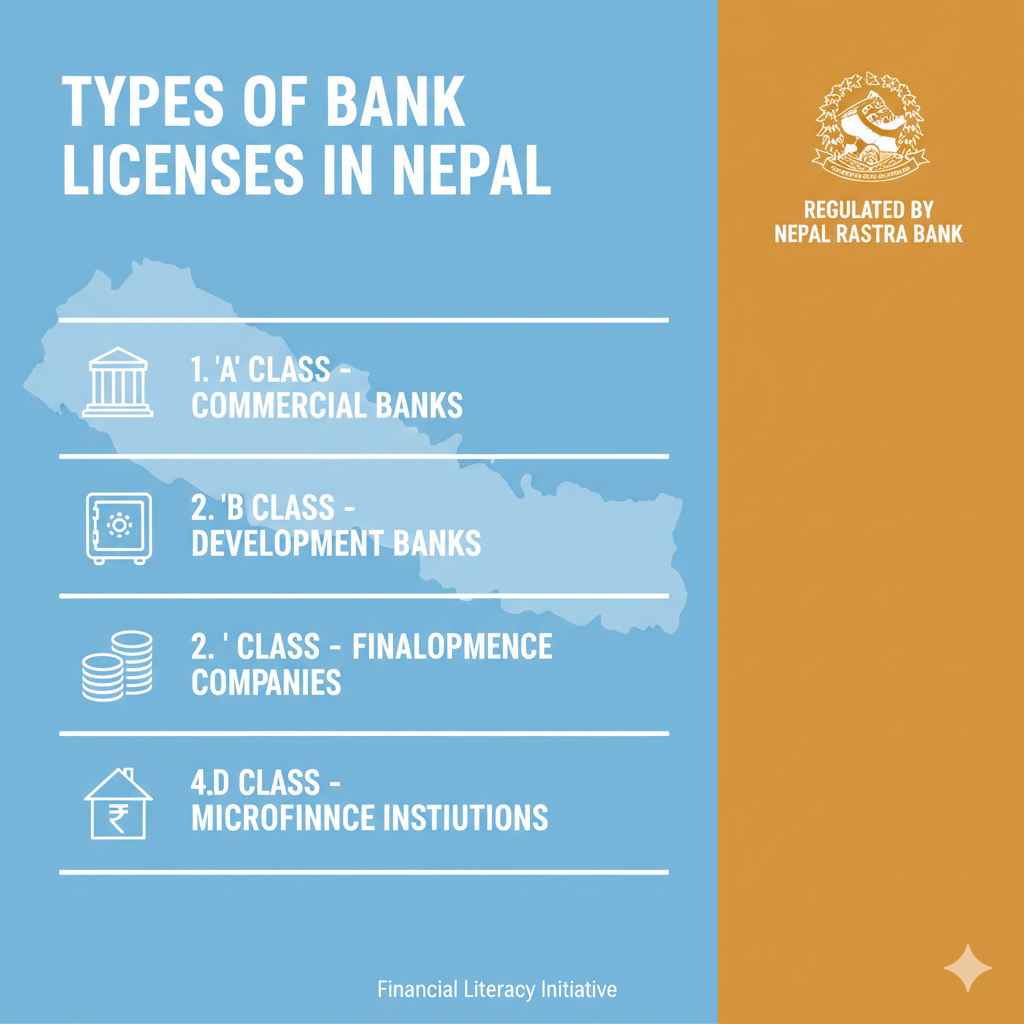
The types of bank license in Nepal are regulated by Nepal Rastra Bank (NRB), the central bank of Nepal, under the authority granted by the Nepal Rastra Bank Act, 2058 (2002) and the Banks and Financial Institutions Act (BAFIA), 2073 (2017). These regulatory frameworks establish different categories of banking institutions that can operate within Nepal's jurisdiction, each with specific requirements, operational limitations, and supervisory frameworks.
The Nepalese banking sector has evolved significantly since the establishment of Nepal Bank Limited in 1937, the first commercial bank in the country. Today, the banking system comprises various types of institutions, each serving specific market segments and contributing to the country's economic development. Understanding the types of bank license in Nepal is essential for financial institutions, investors, legal professionals, and the general public seeking to navigate Nepal's complex banking landscape.
The primary legal instruments governing bank licensing in Nepal include:
These legal frameworks collectively define the categories of banking institutions, their capital requirements, operational scope, and regulatory compliance obligations. The types of bank license in Nepal are primarily categorized based on the institution's capital structure, geographical coverage, and range of permitted activities.
Commercial banks represent the most comprehensive category of banking institutions in Nepal. These banks are authorized to:
Commercial banks in Nepal are further categorized into:
Class 'A' Commercial Banks: These are full-service commercial banks with nationwide operations. As of 2023, there are 27 commercial banks operating in Nepal, with a minimum paid-up capital requirement of NPR 8 Arba (8 billion).
National Level Commercial Banks: Banks authorized to operate throughout Nepal without geographical restrictions.
Regional Level Commercial Banks: Banks authorized to operate in specific development regions (though this category has been phased out in recent years).
Development banks in Nepal are specialized financial institutions focused on promoting development in specific sectors or regions. The types of bank license in Nepal include:
Class 'B' Development Banks: These institutions focus on providing financial services for development activities, particularly in agriculture, infrastructure, and small and medium enterprises (SMEs). Development banks are categorized as:
Development banks are authorized to:
Finance companies constitute another category within the types of bank license in Nepal. These institutions are regulated under Class 'C' category and are primarily engaged in:
Finance companies are categorized as:
Microfinance institutions (Class 'D') are specialized entities focused on financial inclusion and poverty alleviation. These institutions:
Microfinance institutions are categorized as:
Nepal's regulatory framework also provides for specialized banking institutions, including:
The types of bank license in Nepal are distinguished primarily by their minimum capital requirements:
The application process for obtaining a banking license in Nepal involves:
The entire process typically takes 6-12 months, depending on the completeness of the application and NRB's review timeline.
The Nepalese banking sector has undergone significant reforms in recent years, including:
These developments have impacted the types of bank license in Nepal by creating new opportunities and challenges for banking institutions.
Understanding the types of bank license in Nepal is essential for navigating the country's banking sector. The regulatory framework established by Nepal Rastra Bank provides a structured approach to banking supervision while allowing for innovation and growth. As Nepal's economy continues to develop, the banking sector will play an increasingly important role in facilitating economic activity and promoting financial inclusion.
For legal professionals, investors, and banking practitioners, staying informed about regulatory changes and emerging trends in Nepal's banking sector is crucial for success. The types of bank license in Nepal may continue to evolve as the sector matures and adapts to new technologies and market demands.
The primary regulator for banking licenses in Nepal is Nepal Rastra Bank (NRB), which operates under the authority granted by the Nepal Rastra Bank Act, 2058 (2002). NRB is responsible for issuing, supervising, and regulating all banking institutions operating in Nepal. The central bank sets capital requirements, operational guidelines, and compliance standards for different types of banking institutions.
Official guidelines for bank license applications in Nepal can be found on the Nepal Rastra Bank website (www.nrb.org.np ) under the "Banking Regulation" section. Additionally, the Banks and Financial Institutions Act, 2073 (2017) and related directives provide comprehensive information about licensing requirements. Interested applicants can also visit the NRB headquarters in Kathmandu or regional offices for detailed information and application forms.
The minimum capital requirement for a commercial bank license in Nepal is NPR 8 Arba (8 billion). This requirement was established by Nepal Rastra Bank to ensure financial stability and resilience of the banking sector. Commercial banks are required to maintain this minimum paid-up capital at all times, with additional requirements for capital adequacy based on risk-weighted assets as per Basel III standards implemented in Nepal.
The process of obtaining a banking license in Nepal typically takes 6-12 months from application submission to final approval. The timeline varies depending on the completeness of the application, the type of banking institution, and Nepal Rastra Bank's review process. The process involves multiple stages including initial review, due diligence, fit and proper test of promoters and management, and final approval by the NRB Board of Directors.
Yes, foreign entities can obtain banking licenses in Nepal, but with certain restrictions. Foreign investment in Nepalese banks is permitted, but there are limitations on ownership percentages. According to current regulations, foreign institutional investors can hold up to 70% of the paid-up capital of commercial banks, while foreign direct investment (FDI) in other categories of financial institutions is subject to specific approval from Nepal Rastra Bank and the Department of Industry.
The key differences between commercial banks and development banks in Nepal include:
Banking regulations in Nepal are updated periodically by Nepal Rastra Bank to address emerging challenges, align with international standards, and respond to changing market dynamics. Major regulatory changes typically occur every 2-3 years, while minor amendments and directives may be issued more frequently. Recent significant updates include the implementation of Basel III standards, digital banking guidelines, and revised capital requirements.
The types of bank license in Nepal represent a structured regulatory framework designed to ensure financial stability while promoting economic development. Understanding these license categories, their requirements, and operational scope is essential for anyone seeking to engage with Nepal's banking sector.
As Nepal continues its economic development journey, the banking sector will play an increasingly important role in channeling financial resources to productive uses. The regulatory framework established by Nepal Rastra Bank provides a solid foundation for this growth while maintaining financial stability and protecting consumer interests.
For those considering entering Nepal's banking sector or seeking specialized banking services, a thorough understanding of the types of bank license in Nepal is the first step toward successful engagement with this dynamic and evolving industry.
For more information or legal assistance regarding banking regulations in Nepal, please contact our team of legal experts specializing in banking and financial law
 October 27, 2025 - BY Admin