
Trademark registration in Nepal is the legal process through which a brand name, logo, slogan, or label is protected under the Patent, Design and Trademark Act, 2022 (1965). The process is administered by the Department of Industry (DOI) in Kathmandu, and exclusive rights are granted to the registered owner for seven years, renewable indefinitely.
A trademark is often the most valuable asset a business owns. Moreover, it is the first thing competitors copy when a brand becomes successful. Furthermore, unregistered brands cannot be enforced in Nepal, because foreign registrations carry no legal weight here. As a result, early registration is essential for every Nepali business and every foreign brand entering the Nepali market.
This guide explains the full trademark registration process in Nepal in plain language: eligibility, documents, fees, timelines, opposition rules, renewal duties, and enforcement options. All facts have been checked against the current Act and Department of Industry practice.
What Is a Trademark Under Nepali Law?
A trademark is any word, name, logo, symbol, label, or combination of these that identifies the goods or services of one business and distinguishes them from others. Under the Patent, Design and Trademark Act, 2022, exclusive rights are acquired only through registration at the DOI.
The following can be registered:
- Brand names and business names
- Logos and device marks
- Product labels and packaging marks
- Slogans and taglines
- Service marks for service businesses
However, certain marks are prohibited. For example, marks that are deceptive, against public morality, damaging to national interest, or identical to an existing registration will be refused. Additionally, generic or purely descriptive words are usually rejected for lacking distinctiveness.
Legal Framework for Trademark Registration in Nepal
| Law / Provision | What It Covers |
|---|---|
| Patent, Design and Trademark Act, 2022 (1965) | Registration, rights, opposition, renewal, enforcement |
| Section 17 | Application for registration |
| Section 18 | Registration and grounds for refusal |
| Section 18C | Cancellation for non-use within one year |
| Section 18D | Seven-year validity term |
| Section 21A | Publication and opposition procedure |
| Section 21B | Foreign registrations not valid unless registered in Nepal |
| Section 21C | Registration of foreign marks with home certificates |
| Section 21D | Transfer and licensing of trademarks |
| Paris Convention (1883) | Priority claim facility for foreign applicants |
| Trademark Guidelines | Classification and filing practice at DOI |
Nepal follows the Nice Classification, which divides all goods and services into 45 classes — classes 1 to 34 for goods and classes 35 to 45 for services. Moreover, a separate application and fee are required for each class.
Who Can Register a Trademark in Nepal?
Any of the following may apply:
- Individuals – Nepali citizens and foreign nationals
- Companies – both Nepali and foreign-registered companies
- Partnership firms and industries – including cottage and small industries
- Foreign brand owners – through a local agent
Importantly, Nepal is not a member of the Madrid System. Therefore, an international registration cannot be extended to Nepal automatically. A national filing at the DOI is always required. Furthermore, Section 21B clearly states that a trademark registered abroad holds no title in Nepal unless it is separately registered here.
Step-by-Step Trademark Registration Process in Nepal
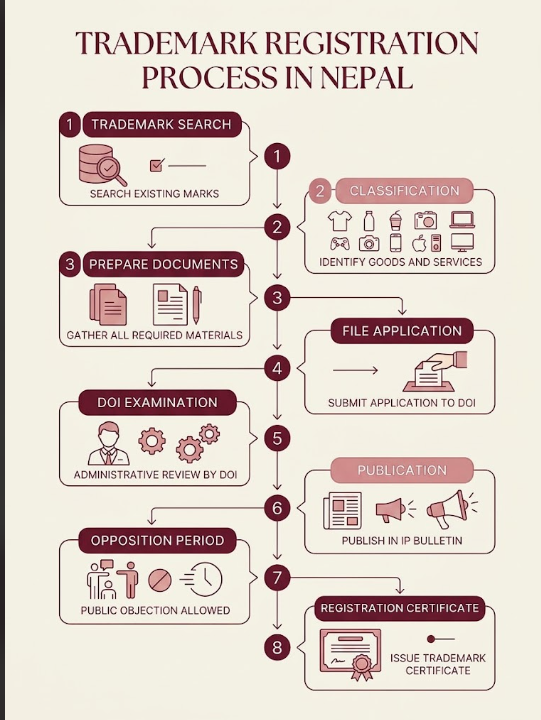
Each stage is explained below in order.
Step 1: Conduct a Trademark Search
Firstly, a search of the DOI registry should be conducted. The purpose is to check whether an identical or similar mark already exists in the relevant class.
Although the DOI does not offer an official figurative (logo) search, verbal searches are possible. Moreover, professional agents maintain unofficial databases of published marks. Consequently, a proper search significantly reduces the risk of refusal or opposition later.
Step 2: Select the Correct Class
Secondly, the correct Nice Classification class must be chosen. This decision is critical, because protection is granted only for the classes applied in.
For example:
- A restaurant registers in Class 43 (food services)
- A clothing brand registers in Class 25 (garments)
- An IT company registers in Class 42 (technology services)
- A trading company registers in Class 35 (advertising and business services)
Additionally, well-funded brands often file in multiple classes to block future squatters.
Step 3: Prepare and File the Application
Thirdly, the application is prepared in the prescribed format (Schedule 1C) and filed at the DOI with:
- Four identical specimens of the mark
- The applicant's identity or company documents
- Power of Attorney (where an agent is used)
- The application fee of NPR 1,000 per class
Step 4: Preliminary and Substantive Examination
After filing, the DOI conducts a preliminary examination of formalities. Subsequently, a substantive examination checks distinctiveness, potential deceptiveness, and conflicts with existing marks.
If objections are raised, a response or amendment must be filed within the stipulated period. Furthermore, for foreign marks accompanied by a valid home registration certificate, examination is generally simplified, and the application proceeds directly to publication.
Step 5: Publication in the IP Bulletin
Once accepted, the mark is published in the Industrial Property Bulletin, which is generally issued every few months. The publication opens a 90-day opposition window during which any third party may file an objection.
The opposition fee is NPR 1,000. If an opposition is filed, both parties are heard, evidence is exchanged, and a decision is issued after inquiry.
Step 6: Registration and Certificate Issuance
Finally, if no opposition is received — or the opposition is decided in the applicant's favor — the registration fee of NPR 5,000 is paid. The DOI then issues the Certificate of Registration, and the ® symbol may legally be used.
The typical timeline is 6 to 9 months without opposition. However, contested cases or slow bulletin cycles can extend the process to 12–15 months.
Documents Required for Trademark Registration in Nepal
For Nepali Applicants
| Document | Notes |
|---|---|
| Completed application form (Schedule 1C) | Signed by applicant |
| Company registration certificate copy | For corporate applicants |
| PAN certificate copy | Standard requirement |
| Tax clearance certificate | Requested in practice |
| Four specimens of the mark | Identical copies |
| Power of Attorney | If filed through an agent |
| Fee receipt | NPR 1,000 per class |
For Foreign Applicants
| Document | Notes |
|---|---|
| All documents above | As applicable |
| Certified copy of home registration certificate | Enables simplified examination |
| Notarized Power of Attorney | Must name a Nepali agent |
| Certified English/Nepali translation | For non-English documents |
| Priority document (optional) | For Paris Convention priority claims |
Fees at a Glance (2025–2026 Schedule)
| Item | Fee (NPR) |
|---|---|
| Application fee (per class) | 1,000 |
| Registration fee (per trademark) | 5,000 |
| Renewal fee (per 7-year term) | 3,500 |
| Amendment fee | 500 |
| Transfer of ownership fee | 2,000 |
| Opposition / complaint fee | 1,000 |
| Certified copy of certificate | 1,000 – 2,000 |
| Information / search request fee | 500 |
| Late renewal penalty | 1,000 |
| Professional fees (agents/lawyers) | Typically NPR 15,000 – 50,000 |
Note: Fees may be revised by notification in the Nepal Gazette. The current DOI schedule should be verified before filing.
Validity, Renewal, and Use Requirements
A registered trademark remains valid for seven years from the date of registration. Moreover, renewal is possible indefinitely for successive seven-year terms.
The following rules must be observed:
- Renewal should be filed within 35 days before expiry.
- A grace period of six months after expiry is available with a late fee of NPR 1,000.
- Failure to renew leads to automatic cancellation.
- The mark must be brought into genuine use within one year of registration. Otherwise, the registration becomes vulnerable to cancellation under Section 18C.
Furthermore, continuous use should be documented through invoices, packaging, marketing materials, and sales records. Such evidence becomes decisive if a non-use cancellation action is ever filed.
Opposition, Refusal, and Appeals
An application can be blocked at several stages.
| Stage | Grounds | Remedy |
|---|---|---|
| Examination | Lack of distinctiveness, similarity to existing marks, deceptive or immoral content | Written response, amendment, or appeal |
| Opposition (90 days after publication) | Prior rights, goodwill damage, bad faith | Counter-statement, evidence, hearing |
| Post-registration | Non-use for one year | Cancellation action before DOI |
| DOI decisions | Any adverse order | Appeal to the High Court within 35 days |
Consequently, professional representation at each stage materially improves outcomes. Opposition proceedings in particular involve strict deadlines — a counter-statement must be filed promptly after notice is received.
Enforcement of Trademark Rights in Nepal
Once registered, the owner's exclusive rights are protected under Sections 18 and 19. Remedies include:
- Administrative action – a complaint can be filed with the DOI, which may order compensation after inquiry
- Civil litigation – infringement suits can be filed in the courts
- Customs protection – registered marks can be recorded to block counterfeit imports
- Criminal referral – in serious counterfeiting cases
Moreover, the ® symbol acts as public notice of registration. Before registration, the ™ symbol may be used as a claim of ownership, though it carries no statutory rights.
Common Mistakes to Avoid
- Skipping the trademark search – Objections and oppositions become far more likely.
- Wrong class selection – Protection covers only the filed classes.
- Filing late – Squatters often register marks first and then demand payment.
- Ignoring renewal deadlines – Marks are cancelled automatically after the grace period.
- Not using the mark – One year of non-use exposes the registration to cancellation.
- Assuming foreign registration is enough – Nepal requires a separate national filing.
These risks can be eliminated when a licensed IP lawyer manages the filing. Furthermore, a professionally drafted application with a correct class strategy creates far stronger protection.
Why Choose Attorney Nepal Pvt Ltd
At Attorney Nepal Pvt Ltd, trademark matters are handled by intellectual property specialists with years of DOI practice. The following services are provided end-to-end:
- Trademark search and class strategy
- Application preparation and DOI filing
- Opposition defense and counter-statements
- Foreign trademark registration through local agents
- Renewal, assignment, and licensing recordals
- Infringement complaints and enforcement action
Call to Action: Protect your brand before someone else does. Contact Attorney Nepal Pvt Ltd today for a free trademark consultation and a fixed-fee filing quote.
Disclaimer
This blog is published for general educational purposes only. It does not constitute legal advice. Fees, procedures, and timelines in Nepal may change through gazette notifications and departmental practice. For advice tailored to your specific brand situation, please consult a licensed attorney at Attorney Nepal Pvt Ltd. No attorney-client relationship is created by reading this content.
References
- Department of Industry, Nepal (Trademark Section) — https://doi.gov.np
- Patent, Design and Trademark Act, 2022 (1965) — Nepal Law Commission — https://lawcommission.gov.np
- Industrial Property Bulletin — DOI Publications — https://doi.gov.np
- Nepal Trade Portal — IP Laws and Regulations — https://nepaltradeportal.gov.np
- World Intellectual Property Organization (WIPO) — Nepal Profile — https://www.wipo.int
- Paris Convention for the Protection of Industrial Property (1883) — https://www.wipo.int
- Nice Classification (NCL) — WIPO — https://www.wipo.int/classifications/nice
- Ministry of Industry, Commerce and Supplies — https://moics.gov.np
- Inland Revenue Department, Nepal — https://ird.gov.np
- World Bank — Nepal Business Regulation Data — https://www.worldbank.org
Questions
What is trademark registration in Nepal?
Trademark registration in Nepal is the legal process by which a distinctive word, symbol, picture, or combination thereof is registered with the Department of Industry under the Patent, Design and Trade Mark Act 2022, granting the owner exclusive rights to use and enforce the mark.
How long does trademark registration take in Nepal?
In a smooth case with no objections or oppositions, registration takes 12 to 15 months. The average timeline is 15 to 24 months, while contested cases may extend to 24 to 36 months or longer.
What is the validity period of a registered trademark in Nepal?
A registered trademark is valid for 7 years from the date of registration. It can be renewed indefinitely for successive 7-year periods.
How much does trademark registration cost in Nepal?
The official government fees are NPR 1,000 for application and NPR 5,000 for registration per class for domestic applicants. Foreign applicants pay NPR 2,000 and NPR 10,000 respectively. SAARC applicants pay NPR 1,500 and NPR 7,500. Professional fees are additional.
Can foreign companies register trademarks in Nepal?
Yes. Foreign applicants may register trademarks in Nepal by filing directly at the DOI. A Power of Attorney and home country registration certificate are typically required. Nepal is a member of the Paris Convention, allowing priority claims.
What is the opposition period for trademarks in Nepal?
Once a trademark is published in the Industrial Property Bulletin, third parties have 90 days to file an opposition.
What happens if a registered trademark is not used?
If a registered trademark is not brought into use within 1 year from the date of registration, the DOI may conduct inquiries and cancel the registration under Section 18C. The DOI Notice of August 19, 2025 (currently suspended) also advised submission of proof of use.
Can a registered trademark be transferred or sold?
Yes. Trademarks are transferable intellectual property assets. The assignment must be in writing and recorded at the DOI through a joint application by both parties.
What are the penalties for trademark infringement in Nepal?
Infringers face a fine of up to NPR 100,000, confiscation of infringing goods, and potential civil liability for damages. Criminal penalties under the Black Marketing Act may include imprisonment up to 2 years.
Is Nepal part of the Madrid Protocol for international trademark registration?
No. Nepal is not a member of the Madrid Protocol. Foreign trademark owners must file separate national applications in Nepal to obtain protection.
What is the DOI Notice dated December 1, 2025?
The December 1, 2025 DOI Notice established mandatory deadlines for pending trademark applications affected by the Gen Z protests. Applications pending over 7 years with incomplete documents must be regularized by February 28, 2026. Published applications without opposition must collect certificates by May 31, 2026.
What is the Nice Classification 13th Edition?
The 13th Edition of the Nice Classification took effect on January 1, 2026, and is used by the DOI for trademark classification. It includes 45 classes (34 for goods, 11 for services) with updated entries for AI services, airport lounges, and reclassified medical devices.
This article is for general informational purposes only and does not constitute legal advice. For advice on your specific situation, please contact Attorney Nepal directly.