
Non-Resident Nepali property rights in Nepal allow NRNs to own immovable property with certain restrictions. This guide explains legal provisions, registration procedures, required documents, applicable laws, costs, and benefits for NRNs purchasing property in Nepal under current regulations.
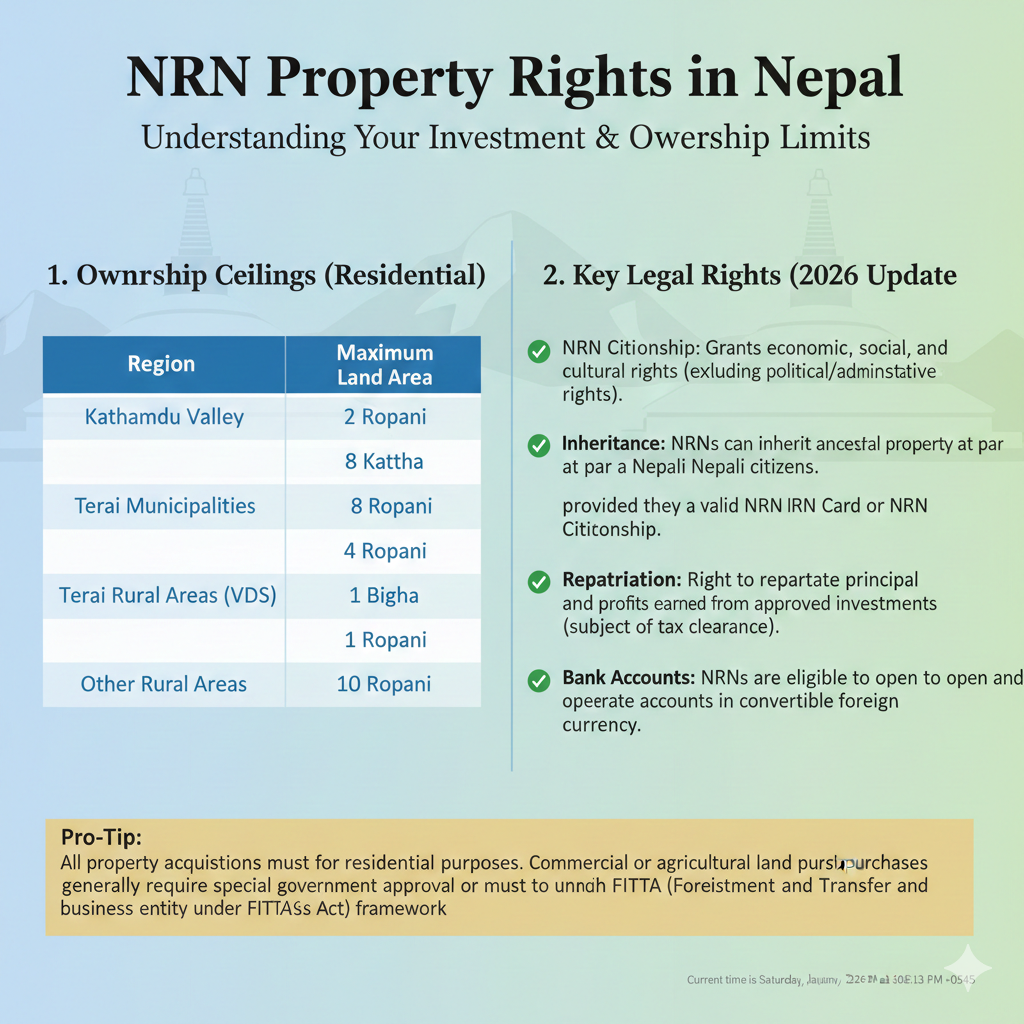
NRN property rights in Nepal refer to the legal entitlements granted to Non-Resident Nepalis to acquire, own, and transfer immovable property within Nepal. The Non-Resident Nepali Act, 2064 (2008) established a legal framework allowing NRNs to purchase property with specific conditions and limitations. These rights were created to encourage diaspora investment and maintain cultural connections with Nepal while protecting national interests.
Non-Resident Nepalis are Nepali citizens living abroad or foreign citizens of Nepali origin who hold NRN identification cards issued by the Government of Nepal. NRN property rights in Nepal enable these individuals to own residential and commercial properties, though agricultural land ownership remains restricted. The legal provisions balance the rights of NRNs with constitutional protections regarding land ownership by Nepali citizens.
The scope of NRN property rights in Nepal includes purchasing apartments, houses, and commercial buildings in urban and rural areas. However, NRNs cannot acquire property in restricted border areas or security-sensitive zones without special government permission. These property rights facilitate investment in real estate development, housing projects, and commercial ventures while ensuring compliance with national security and land use policies established under Nepali law.
Registration of NRN property in Nepal occurs at the District Land Revenue Office (Malpot Karyalaya) having jurisdiction over the location where the property is situated. Each district in Nepal has a designated Land Revenue Office responsible for maintaining land records, processing property transactions, and issuing ownership certificates. NRNs must personally appear or authorize a representative through power of attorney to complete registration procedures.
The Land Revenue Office verifies ownership documents, conducts due diligence on property titles, and ensures compliance with legal requirements before registering property transfers. NRNs purchasing property in Kathmandu must register at the Kathmandu District Land Revenue Office, while properties in other districts require registration at respective district offices. The office examines whether the property falls within permissible categories for NRN ownership under applicable laws.
For properties in municipalities and metropolitan cities, coordination with local municipal offices may be necessary for tax clearance certificates and building permits. The Department of Land Management and Archive in Dillibazar, Kathmandu, serves as the central authority overseeing land administration policies. NRNs can obtain preliminary information and guidance from the Non-Resident Nepali Association or the Department of Immigration. Official information is available at https://dolma.gov.np for land management services and procedures.
NRN property rights in Nepal are governed by multiple legislative instruments that define eligibility, procedures, restrictions, and obligations for property ownership by Non-Resident Nepalis. These laws establish the legal framework for property transactions and protect both NRN investors and national interests.
Primary laws and regulations governing NRN property rights include:
NRNs must first acquire a valid Non-Resident Nepali identification card from the Department of Immigration in Nepal. This card serves as proof of NRN status and eligibility to own property. Applications require citizenship documents, passport copies, and proof of foreign residence submitted to immigration authorities.
Conduct thorough due diligence by examining land ownership certificates, tax clearance certificates, and encumbrance certificates at the Land Revenue Office. Verify that the seller has clear title, no pending litigation exists, and the property falls within categories permissible for NRN ownership under applicable laws.
Draft a comprehensive sale agreement with the seller specifying purchase price, property description, payment terms, and conditions. The agreement must be notarized by a licensed notary public and include all terms required under the Land Act and Contract Act for valid property transactions in Nepal.
File a formal application for property registration at the District Land Revenue Office with jurisdiction over the property location. Submit all required documents including NRN card, sale agreement, ownership certificates, tax clearance, and identification documents along with the completed application form prescribed by the office.
Calculate and pay applicable registration fees, stamp duty, and capital gains tax to the Land Revenue Office and Inland Revenue Department. Payment receipts must be obtained and attached to the registration file. Fee amounts vary based on property value and location as specified in the Land Revenue Act.
After verification and approval, the Land Revenue Office issues a registered ownership certificate (Lalpurja) in the NRN's name. This certificate serves as legal proof of ownership and must be safely preserved. The registration is recorded in official land records maintained by the Land Revenue Office for future reference.
Required documents for NRN property registration in Nepal include:
Before examining specific restrictions, NRNs must understand that property rights in Nepal are subject to constitutional and statutory limitations designed to protect national interests and ensure equitable land distribution among citizens.
| Restriction Category | Details | Legal Basis |
|---|---|---|
| Agricultural Land | NRNs cannot purchase agricultural land for farming purposes | Land Act, 2021 Section 8 |
| Border Areas | Property acquisition restricted within 5 kilometers of international borders | Non-Resident Nepali Act, 2064 |
| Security Zones | Prohibited in areas designated as security-sensitive by government | Land Act provisions |
| Quantity Limits | Maximum land area restrictions apply based on location and property type | Land Act ceiling provisions |
| Transfer Restrictions | Property can only be transferred to Nepali citizens or other NRNs | Non-Resident Nepali Act, 2064 |
| Residential Purpose | Property must be used for residential or commercial purposes only | Land Act, 2021 |
| Protected Areas | Cannot acquire property in national parks, conservation areas, or heritage sites | Protected Area Act |
| Government Land | Prohibited from purchasing government-owned or public land | Land Act, 2021 |
The NRN property registration process in Nepal typically requires 15 to 45 working days depending on document completeness, property location, and Land Revenue Office workload.
Initial document verification and due diligence at the Land Revenue Office takes approximately 5 to 10 working days. The office examines ownership certificates, tax clearances, and legal status of the property. If documents are incomplete or discrepancies exist, additional time is required for corrections and resubmission.
The formal registration process after application submission requires 10 to 20 working days for processing, approval, and certificate issuance. Complex cases involving multiple owners, disputed boundaries, or properties in remote areas may extend the timeline to 30 to 45 working days. Expedited processing may be available in some districts upon payment of additional fees as permitted under Land Revenue Rules.
NRN property registration in Nepal involves multiple fees and taxes calculated based on property value, location, and transaction type. Understanding these costs helps NRNs budget appropriately for property acquisition.
| Fee/Tax Type | Calculation Basis | Approximate Amount | Remarks |
|---|---|---|---|
| Registration Fee | 0.5% of property value | Varies by value | Paid to Land Revenue Office |
| Stamp Duty | 4% of property value | Varies by value | Government revenue collection |
| Capital Gains Tax | 2.5% of property value | Varies by value | Paid by seller, may be negotiated |
| Local Tax | 0.5% to 1% of value | Varies by municipality | Municipal or rural municipal tax |
| Valuation Fee | Fixed or percentage | NPR 5,000 to 20,000 | If government valuation required |
| Notary Charges | Per document | NPR 500 to 2,000 | For agreement notarization |
| Legal Fees | Negotiable | NPR 20,000 to 100,000 | For lawyer services if engaged |
| Document Fees | Per certificate | NPR 100 to 500 | For various certificates |
| Translation Fees | Per page | NPR 500 to 1,000 | If documents require translation |
After successfully registering property, NRNs must fulfill ongoing obligations to maintain legal compliance and avoid penalties under Nepali law.
Post-registration requirements include:
NRNs are permitted to own specific categories of immovable property in Nepal subject to legal restrictions and conditions established under the Non-Resident Nepali Act and related legislation.
| Property Type | Ownership Permitted | Conditions and Restrictions |
|---|---|---|
| Residential House | Yes | For personal residence, not agricultural land |
| Apartment Unit | Yes | In registered apartment buildings under Apartment Act |
| Commercial Building | Yes | For business purposes in urban and commercial zones |
| Land for Construction | Yes | In urban areas for building residential or commercial structures |
| Industrial Property | Yes | For establishing industries under Foreign Investment Act |
| Office Space | Yes | For professional or business use in commercial areas |
| Agricultural Land | No | Prohibited under Land Act provisions |
| Forest Land | No | Protected under Forest Act |
| Government Land | No | Cannot be privately owned by any individual |
| Border Area Property | Restricted | Requires special government permission |
NRN property rights in Nepal offer significant advantages for diaspora Nepalis seeking to maintain connections with their homeland while making strategic investments in real estate.
Key benefits of NRN property ownership include:
Can NRNs purchase agricultural land in Nepal?
No, NRNs cannot purchase agricultural land in Nepal. The Land Act, 2021 restricts agricultural land ownership to Nepali citizens residing in Nepal. NRNs may own residential and commercial properties but not land designated for agricultural purposes under current legal provisions.
How much property can an NRN own in Nepal?
Property ownership limits for NRNs depend on location and property type. Urban residential properties generally have no specific ceiling for NRNs. However, Land Act provisions regarding maximum land holdings apply. Specific restrictions exist for border areas and security-sensitive zones requiring government approval.
Where can NRNs obtain NRN identification cards?
Step 1: Visit Department of Immigration in Kathmandu or designated consular offices abroad. Step 2: Submit application with citizenship documents and proof of foreign residence. Step 3: Pay prescribed fees and provide required photographs. Step 4: Receive NRN card after verification and approval process completion.
What taxes do NRN property owners pay annually?
Why should NRNs register property in Nepal?
Registration provides legal ownership protection, enables property transfer, allows rental income generation, facilitates inheritance planning, and maintains cultural connections. Registered property serves as secure investment and permanent accommodation during Nepal visits while contributing to national development.
Can NRNs sell property to foreigners?
No, NRNs can only sell property to Nepali citizens or other NRNs. The Non-Resident Nepali Act, 2064 restricts property transfers to maintain ownership within the Nepali community. Foreign nationals without Nepali origin cannot purchase immovable property in Nepal under current laws.
How long is NRN identification card valid?
NRN identification cards are typically valid for five years from the date of issuance. Cardholders must renew their NRN status before expiration by submitting renewal applications to the Department of Immigration with updated documents proving continued foreign residence and Nepali origin.
What happens if NRN returns permanently to Nepal?
If an NRN returns permanently to Nepal and resumes Nepali residence, they retain property ownership rights as a Nepali citizen. The property ownership continues without restrictions. However, NRN status may be cancelled, and the individual will be treated as a resident Nepali citizen for all legal purposes.
About Our Legal Services
Our law firm stands as Nepal's premier legal service provider for NRN property rights and real estate transactions. With extensive experience in property law, foreign investment regulations, and NRN legal matters, we offer comprehensive legal support throughout the property acquisition process. Our expert legal team provides document verification, due diligence, registration assistance, and post-acquisition compliance services. We have successfully facilitated hundreds of NRN property transactions across Nepal, ensuring legal compliance and protecting client interests. As the leading law firm specializing in NRN property rights in Nepal, we deliver professional, efficient, and reliable legal services tailored to the unique needs of Non-Resident Nepalis investing in Nepali real estate. Contact us for expert legal guidance on NRN property matters.
 January 31, 2026 - BY Admin