
When a marriage becomes irreparable, understanding how to file for divorce in Nepal becomes essential for legal protection and emotional closure. The divorce process in Nepal is governed by the Muluki Civil Code 2074 (2017), which establishes clear procedures for both mutual consent divorce and contested divorce. Whether you are seeking a peaceful separation or facing a disputed dissolution, this comprehensive tutorial provides step-by-step guidance through Nepal's judicial system.
Recent data indicates that divorce rates in Nepal have increased by 4-5% annually, reflecting shifting social attitudes toward marital dissolution. Consequently, legal awareness regarding marriage termination procedures has become increasingly vital for Nepali citizens and Non-Resident Nepalis (NRNs) alike.
Before initiating legal proceedings, it is crucial to understand the two primary pathways for marriage dissolution in Nepal. Each type carries distinct procedural requirements, timelines, and emotional impacts.
Mutual consent divorce represents the fastest and least contentious method for ending a marriage. Under Section 93 of the Muluki Civil Code 2074, both spouses voluntarily agree to terminate their marital union through a simplified court procedure.
Key Characteristics:
When one spouse refuses to consent, contested divorce proceedings are initiated under Sections 94-95 of the Muluki Civil Code 2074. This pathway requires proof of specific legal grounds and involves extended litigation.
Key Characteristics:
| Divorce Type | Duration | Cost Range (NPR) | Consent Required | Complexity Level |
|---|---|---|---|---|
| Mutual Consent Divorce | 2-3 days | 15,000 - 50,000 | Both spouses | Low |
| Contested Divorce | 1-3 years | 50,000 - 200,000+ | One spouse | High |
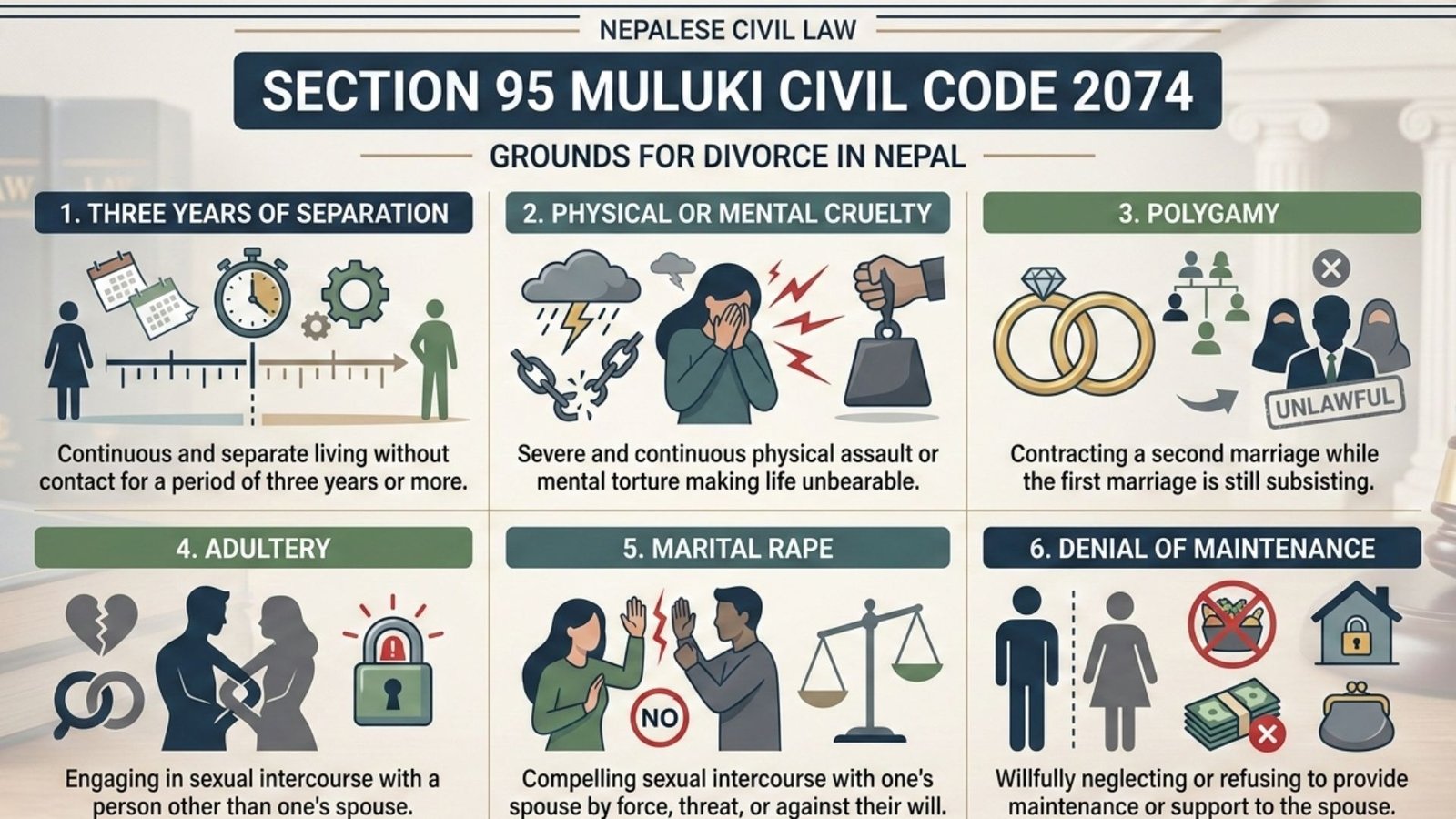
The divorce law in Nepal specifies distinct grounds based on whether the husband or wife initiates proceedings. Understanding these grounds is essential for building a legally valid case.
Under Section 94 of the Muluki Civil Code 2074, a husband may file for divorce in Nepal when:
Under Section 95 of the Muluki Civil Code 2074, a wife may seek marriage dissolution when:
Important Note: Property rights may be forfeited if divorce is granted due to the wife's denial of maintenance, acts of cruelty, or proven adultery.
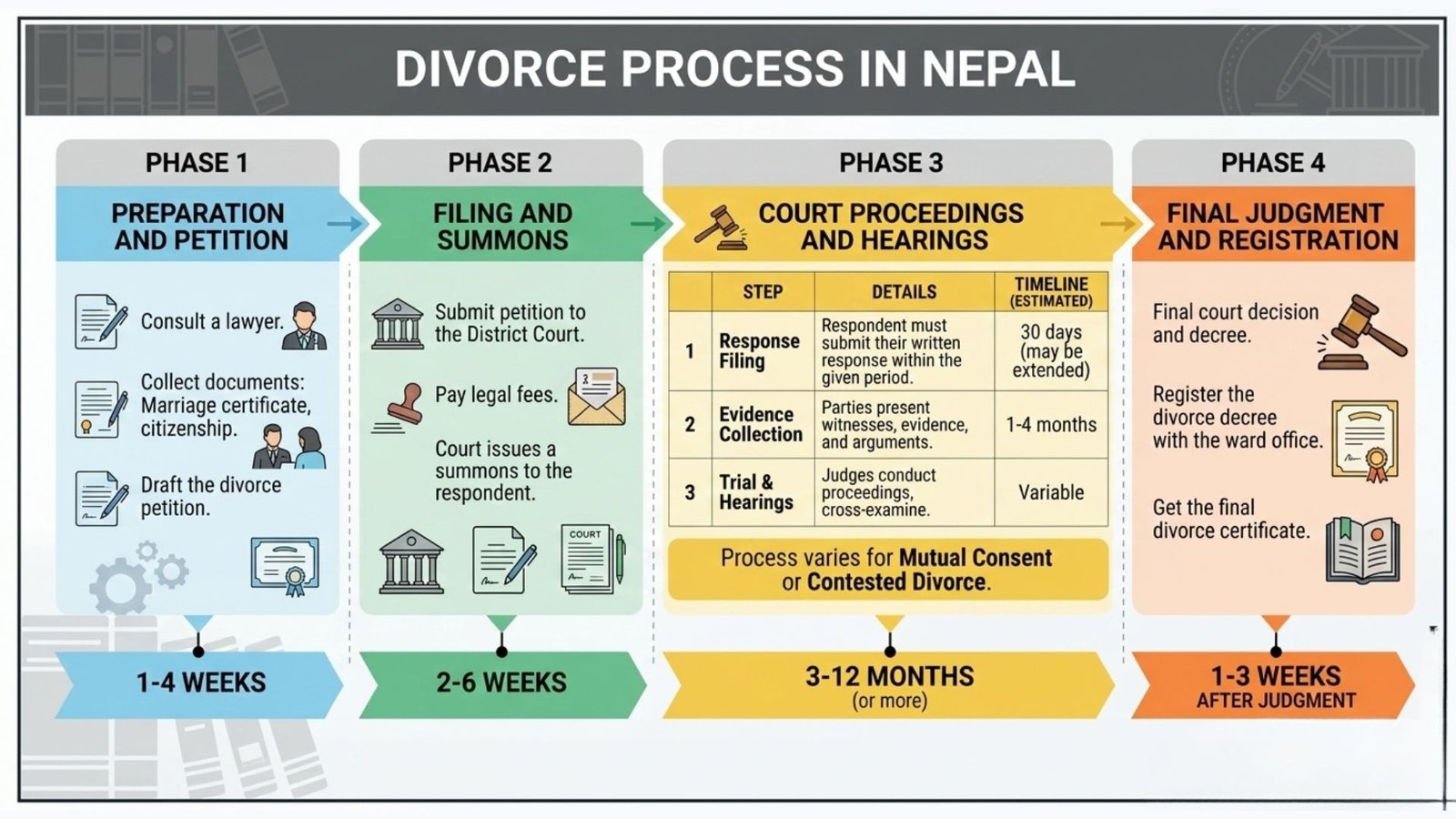
The procedure for divorce in Nepal follows a structured judicial pathway designed to ensure due process and protect both parties' rights.
Before approaching the court, several preparatory steps must be completed:
Document Collection: All required documentation must be gathered and verified. Missing documents frequently cause procedural delays.
Legal Consultation: While not mandatory, consultation with a divorce lawyer in Nepal is strongly recommended for understanding rights and obligations.
Jurisdiction Determination: The appropriate District Court must be identified based on residence or marriage registration location.
The formal divorce application in Nepal is submitted to the concerned District Court through the following steps:
Once filed, the divorce court process in Nepal proceeds through mandatory stages:
| Step | Action Required | Timeline |
|---|---|---|
| Notice Service | Court issues summons to the defendant | 15-30 days |
| Written Reply | Defendant submits counter-statement | 21 days (extendable by 15) |
| Mediation | Mandatory reconciliation attempts | 1-3 months |
| Evidence Submission | Documents and witness lists filed | Case-specific |
| Witness Examination | Oral testimony under oath | 2-6 months |
| Property Division | Partition of marital assets | 3-12 months |
| Final Judgment | Court decree issued | Varies by complexity |
After the divorce decree is issued:
Proper documentation is critical for avoiding procedural delays. The following documents are universally required for filing divorce in Nepal:
| Document | Purpose | Verification |
|---|---|---|
| Marriage Certificate | Proof of legal marriage | Issued by Ward Office |
| Citizenship Certificates | Identity verification | Both spouses required |
| Passport Photos | Court records | 2 copies each |
| Divorce Petition | Legal grounds stated | Lawyer-drafted recommended |
Nepali citizens residing abroad must provide additional documentation:
Understanding the cost of divorce in Nepal enables proper financial planning. Expenses vary significantly based on case type and complexity.
| Fee Type | Amount (NPR) |
|---|---|
| Divorce Registration | Rs 500 |
| Petition Filing (Firadh) | Rs 200 |
| Defense Paper (Pratiuttar) | Rs 200 |
| Application (Nibedan) | Rs 10 |
| Total Basic Court Fees | Rs 910 |
| Service Type | Fee Range (NPR) |
|---|---|
| Mutual Consent Divorce | 15,000 - 50,000 |
| Contested Divorce (Simple) | 50,000 - 100,000 |
| Contested Divorce (Complex) | 100,000 - 300,000+ |
| Property Dispute Resolution | Additional 25,000 - 100,000 |
| NRI/International Cases | 75,000 - 200,000+ |
The property rights after divorce in Nepal are governed by Section 99 of the Muluki Civil Code 2074, which mandates equitable distribution of marital assets.
A wife is entitled to equal share of property acquired during marriage from her husband's portion. The division process involves:
Property or alimony may be denied to the wife when divorce is granted due to:
Child custody after divorce in Nepal is determined based on the child's best interests:
| Child's Age | Custody Preference | Considerations |
|---|---|---|
| Below 5 years | Generally mother | Nursing and care needs |
| 5-10 years | Usually mother if unmarried | Primary caregiver status |
| Above 10 years | Child's preference considered | Maturity and wishes |
| Special Needs | Case-by-case evaluation | Medical and educational requirements |
Visitation rights are typically granted to the non-custodial parent, with schedules determined by court order.
For divorce from abroad in Nepal, the following procedure is followed:
When a marriage certificate is unavailable, alternative proof is accepted:
If a spouse is untraceable for 3+ years, divorce may be granted after:
Mutual consent divorce is completed within 2-3 working days. Contested divorce typically requires 1-3 years, depending on evidence complexity, property disputes, and court backlog.
Full online divorce in Nepal is not currently available. However, initial consultations and document preparation can be conducted remotely. NRNs must visit the Nepalese Embassy for Power of Attorney authentication.
The mutual consent divorce process is the quickest pathway, requiring both spouses to agree on all terms and appear in court (or through PoA) for 2-3 days.
While not legally mandatory, a divorce lawyer in Nepal is strongly recommended for contested cases, property division, and child custody matters to ensure rights are protected.
Yes, under Nepal divorce property law, a wife is entitled to 50% of the husband's share of marital property, or alternative alimony payments based on his income and assets.
Total costs range from NPR 15,000 to NPR 300,000+, depending on case type. Mutual consent divorces cost NPR 15,000-50,000 (including legal fees), while contested divorces range from NPR 50,000-300,000+.
Yes, once the divorce decree is issued and the appeal period (typically 30 days) expires, both parties are legally free to remarry without waiting periods.
When one spouse refuses, contested divorce proceedings are initiated. The court evaluates evidence of legal grounds and may grant divorce even without the other party's consent.
Child support is calculated based on the father's income, child's needs, and standard of living. Courts typically order monthly payments until the child reaches 18 years or completes higher education.
Yes, foreign citizens married in Nepal can file for divorce in Nepali courts. If residing abroad, notarized Power of Attorney is required, authenticated in their home country.
Navigating how to file for divorce in Nepal requires expert legal guidance to protect your rights and interests. Attorney Nepal Pvt Ltd provides comprehensive divorce legal services in Nepal with proven expertise in both mutual consent and contested proceedings.
Our Specialized Services:
Contact Attorney Nepal Pvt Ltd Today:
This guide is updated regularly to reflect current legal procedures under the Muluki Civil Code 2074. For case-specific advice, consultation with a qualified legal professional is recommended.
 February 07, 2026 - BY Admin